Friday, July 25, 2014
We've arrived!
We have safely and successfully arrived in Esteli, Nicaragua! See details about our day and pictures in the Global Glimpse blog. I wrote it for today.

Tuesday, July 22, 2014
To Nicaragua with Global Glimpse
 Summer 2014 means it's time to hit the road once again. This time I'll be traveling with the incredible organization, Global Glimpse. They believe that America's next generation must experience different countries and cultures first-hand to develop into responsible global citizens. I am very excited to be working with them.
 |
| Can you find Esteli? |
 |
| Somoto Canyon |
We will also take some trips to a lagoon and to Somoto canyon for some swimming, canoeing/kayaking, and probably some cliff jumping! This program is better than anything I could have ever designed myself and I am so grateful to be a Global Glimpser leader. I feel like I am finally meshing my dream of combining two of my passions, traveling and teaching.
I can't wait to set foot in Nicaragua again! Yes, again, I was there in 2006 with Wittenberg University (my undergrad alma mater) building houses in Ticuantepe with Bridges to Community. From what I remember, the food while a little heavy on the rice, beans, and plantain side is delicious! The Nicaraguans are so friendly and welcoming when it comes to taking you into their community, and the weather is hot! But hey, it's Central America, what can you expect.
 |
| One of the adorable kiddos that was part of the community we were buiding houses in. |
I will be doing my best to post on here as often as possible but the other place where you can follow our groups travels in on the Global Glimpse Esteli Offical Trip Blog. I have already posted one page there, but a different student is going to update the blog every day so you'll have constant updates about this amazing trip from numerous different perspectives.
The northern mountains of Nicaragua here we come!
Friday, August 9, 2013
Day 6: From Santa Rita Experiemental Range to Southwestern Research Station

On Friday, August 2, I woke up earlier than the set time I was supposed to wake, but later than the entire bunk. Most of the group was up and cleaning by 7am. I had slept til 8. The morning at Santa Rita Experimental Range was pretty uneventful other than a thunderstorm also known as a monsoon ripped over our canyon post breakfast. It was the first time I'd seen so much rain in the desert. We loaded up all the vehicles after lunch and left SRER behind as we drove the 3.5 hour stretch towards Cornado National Park just west of the New Mexico border. We drove on I-10 and saw so many signs for "The thing?" that our interest was exploding by the 26th sign we saw, that Lee and Angela(the head researchers, and our leaders) decided we could stop and see it. I tell you what it wasn't much to see. But if you like really old antique-ish, un-dusted stuff, the rest-top where "The Thing?" is has a lot of it.

When we arrived at South Western Research Station (SWRS), it was beautiful like a temperate paradise in the middle of the desert. It is nestled right in the canyon of the Chiricahua mountains. Sometimes they refer to the mountain ecosystems in Arizona as sky islands because they are so different and isolated from the dry hot ecosystems that extend between the mountain ranges of this area. We had definitely landed on a sky island at SWRS. It was a beautiful natural paradise.


After dinner we had a talk by the famous Doug Tallany about conservation through eco-landscaping (something we can all do, trade out our big un-diverse lawns and put in more native plants that will attract caterpillars and insects, and therefore birds and and other wildlife.) I decided that Farida and I are going to try and work together to start a butterfly garden at my school when we return to NYC. We want her my Juniors and Seniors working with her First graders. This partnership could make for an interesting community action plan.


Finally, we did a night walk with Neil (Dave Wagner's assistant researcher

Saturday, August 3, 2013
Day 5: Sonora Desert Museum and the Sunset after the Storm


Thursday was awesome! We went to the Sonara Desert Museum. Which don’t be fooled is much more a zoo than the traditional museum you’re thinking of. I got to crawl through caves, walk through the desert ecosystem, sit with hummingbirds buzzing around me and see so many different kinds of wildlife, from mountain lions to ocelots, eels, tarantulas, coyote, black bears, rattle snakes, elf owls, javelina, beavers coati, and butterflies, My favorite part was learning about the cacti. Actually my friend Farida and I made a video about cacti for your educational enjoyment.
 After the video, both Michelle and Farida ended up with barbs
in their hands from the prickly pear (yep, we ate the fruit. It was a bit sweet and
extremely seedy, but not in a shady way. ) Furthermore, Farida was showing me how the teddy bear cactus
works (it pretty much allows a limb to fall off if gently knocked completely
damaging whatever is below it as the spines are barbed and face backwards to
create extreme pain as you pull them out. Farida drops this rock on a part of
the TB cactus, a piece falls off and rolls in the path. We can’t leave this
pointy bulb just sitting around, so she goes to throw it, and as she
releases it it slips out of her fingers and the barbs stay attached to her
fingers. Her face showed that it was excruciating.
After the video, both Michelle and Farida ended up with barbs
in their hands from the prickly pear (yep, we ate the fruit. It was a bit sweet and
extremely seedy, but not in a shady way. ) Furthermore, Farida was showing me how the teddy bear cactus
works (it pretty much allows a limb to fall off if gently knocked completely
damaging whatever is below it as the spines are barbed and face backwards to
create extreme pain as you pull them out. Farida drops this rock on a part of
the TB cactus, a piece falls off and rolls in the path. We can’t leave this
pointy bulb just sitting around, so she goes to throw it, and as she
releases it it slips out of her fingers and the barbs stay attached to her
fingers. Her face showed that it was excruciating. 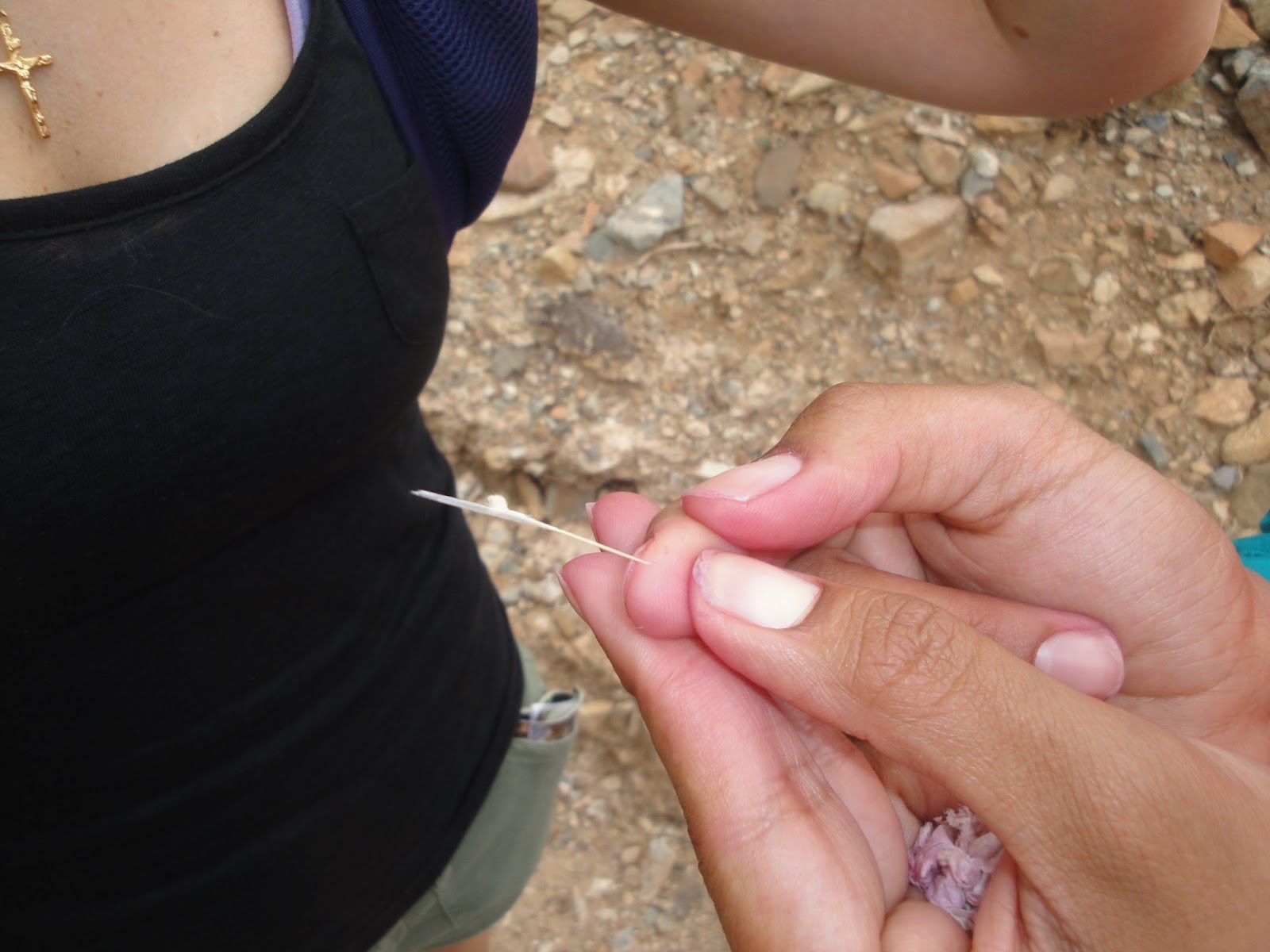
 Later a docent was telling us about how painful pricks from
a cactus can be, it was nearly impossible for me to keep a straight face as
Farida and Michelle simultaneously say, “I can only imagine.” With far too much
conviction. The docent also told us about mesquite powder and jojoba beans.
Mesquite powder is formed by grinding down the seed pods of the mesquite. She
let us try some. It was sweet like sugar with a slight hint of mesquite BBQ
taste. She then explained how jojoba bean oil is in many cosmetics. She pointed
out the shrub the beans come from and let us put some of the tasteless,
odorless, waxy-oil on our hands. It perfectly models the natural oils released
by human skin and hair glands.
Later a docent was telling us about how painful pricks from
a cactus can be, it was nearly impossible for me to keep a straight face as
Farida and Michelle simultaneously say, “I can only imagine.” With far too much
conviction. The docent also told us about mesquite powder and jojoba beans.
Mesquite powder is formed by grinding down the seed pods of the mesquite. She
let us try some. It was sweet like sugar with a slight hint of mesquite BBQ
taste. She then explained how jojoba bean oil is in many cosmetics. She pointed
out the shrub the beans come from and let us put some of the tasteless,
odorless, waxy-oil on our hands. It perfectly models the natural oils released
by human skin and hair glands. 

I was late to dinner but was saved a huge slice of vege
lasagna. I made it just in time for Angela’s talk on Caterpillar immune systems
and parasatoids. We came up with the idea of tracking mortality
rates (due to parsatoids vs. pathogens vs. predators) by injecting caterpillars
with computer chips so you could see how many are preyed on. Maybe someday a scientist will do an experiment using my idea.
Tomorrow (Friday) is cleaning and packing up to head
to South West Research Station, which is supposed to be the ritz of research centers,
guess we’ll see.
Friday, August 2, 2013
Day 4: Adventure Caterpillar Collecting

On Wednesday, I was assigned
to go on a mystery trip with Dr. Wagner. Just to give you some background, Dr.
Wagner is the best caterpillar taxonomist alive. He has identified and named 20
new species, and even has 2 species named after him. Of course, he’s written
some very visually clarifying field guides. He also gets super excited about
caterpillar finds.
To start our trip, we drove down to a canyon near Patagonia, Arizona. It
was much greener and lusher than the canyons around SRER. We were just randomly
driving and crossed a bridge, Doc Wagner got really excited as we passed some
popular trees by the bridge. He pulled over, “Everybody out, we’re going to go
bang on those poplars!” That was the first of 5 random stops we made whenever
he saw the proper host plant of the specific caterpillar he was looking for.


 We
found some really rare specimens including one that had never been photographed
in its last instar (final post malt period of larva stage). It was fun not
knowing when we’d suddenly pull over, be out of the car, banging trees and
shrubs with our tap rods and catch sheets. I got pretty good at spotting
caterpillars without banging branches of trees. I looked for leaves that were freshly eaten to help guide my
vision to a spot on an elderberry bush where I located a little stick-like
caterpillar. When I banged him onto my catch sheet, he’d flop around like a
fish out of water. I called it his “crazy dance.” I discovered this caterpillar on our second stop. Each time we stopped, Dr. Wagner would say that we were going to lunch after the next stop. This process repeated itself 6 times. Truly, not even food is a priority for this scientists, just caterpillars!
We
found some really rare specimens including one that had never been photographed
in its last instar (final post malt period of larva stage). It was fun not
knowing when we’d suddenly pull over, be out of the car, banging trees and
shrubs with our tap rods and catch sheets. I got pretty good at spotting
caterpillars without banging branches of trees. I looked for leaves that were freshly eaten to help guide my
vision to a spot on an elderberry bush where I located a little stick-like
caterpillar. When I banged him onto my catch sheet, he’d flop around like a
fish out of water. I called it his “crazy dance.” I discovered this caterpillar on our second stop. Each time we stopped, Dr. Wagner would say that we were going to lunch after the next stop. This process repeated itself 6 times. Truly, not even food is a priority for this scientists, just caterpillars!

Finally, when he set us free to grab lunch in Patagonia, our group went to a little Mexican food diner and hoped that the monsoon would come in. This time of year it is supposed to
rain quite a bit, but it really hasn't happened since I've been here, so we
we're really hoping it will: the more rain, the more caterpillars. We got ice-cream before
heading back home. We did one last beat on junipers for Lee and then went back
to SRER. I walked the quarter mile to make a few phone calls, and then I
showered and went to dinner.
 We had burritos and they were awesome! We also celebrated Greg’s
birthday with a cake. The icing was a homemade fudge icing (made with melted
chocolate chips and powdered sugar.) It was very sweet. Rory, Michelle and I
stayed after and made the lasagna for Thursday's dinner. We are super planners. I am going
to bed early tonight because tomorrow we are leaving at the crack of dawn to go
to the Sonora Desert Museum. I know what you’re thinking…boooorrrrriiiinnnnggg.
But actually it has a lot of live organisms which means it should be pretty cool. I will tell you more about it soon.
We had burritos and they were awesome! We also celebrated Greg’s
birthday with a cake. The icing was a homemade fudge icing (made with melted
chocolate chips and powdered sugar.) It was very sweet. Rory, Michelle and I
stayed after and made the lasagna for Thursday's dinner. We are super planners. I am going
to bed early tonight because tomorrow we are leaving at the crack of dawn to go
to the Sonora Desert Museum. I know what you’re thinking…boooorrrrriiiinnnnggg.
But actually it has a lot of live organisms which means it should be pretty cool. I will tell you more about it soon..
Day 3: First Day Collecting in the Field
 This was our first full day at SRER. I got up at 6 am and went for a run with Farda, Michelle, and
Tong. We ran down the drive that leads up to the center and it was beautiful. The golden mountains
warming up around us. The first half of the run was easy and mostly all
downhill. The second half of the run was really hard! Not only was it uphill
but I kept getting kind of dizzy and having shaky vision. I took a bottle of
ice water with me to drink during the run, it wasn't dehydration but rather the
altitude that was making me feel so overworked. We are at 4000 feet above sea
level here.
This was our first full day at SRER. I got up at 6 am and went for a run with Farda, Michelle, and
Tong. We ran down the drive that leads up to the center and it was beautiful. The golden mountains
warming up around us. The first half of the run was easy and mostly all
downhill. The second half of the run was really hard! Not only was it uphill
but I kept getting kind of dizzy and having shaky vision. I took a bottle of
ice water with me to drink during the run, it wasn't dehydration but rather the
altitude that was making me feel so overworked. We are at 4000 feet above sea
level here.
After breakfast, the group went into the field and we collected caterpillars
for Lee. The first thing we did when we got to the site was layout the 10 meter
diameter plot. Then we just started to beat every tree and shrub in the area
with our beater sticks or as I like to call them tap rods, and beat-sheets. Check out this video, my friend, Michelle
made. She introduces the VIDEO but I am the main star explaining how to collect
caterpillars using the supplies I just mentioned above.

 As I mention in the video, some of the caterpillars are so
small. It takes a very focused eye to spot them. We left the field after about
2 hours and headed back to the station for lunch. On our way back our car
talked about what science is. In two words all of the teachers in the car had
to describe it. I said, inquiry experimentation. The photographer professor,
Doug, who asked the question said, I was the closest, he said science is hypothesis testing. Lee added that the word science means “to know.” Which make
sense because to be able to know something you have got to test it out.
As I mention in the video, some of the caterpillars are so
small. It takes a very focused eye to spot them. We left the field after about
2 hours and headed back to the station for lunch. On our way back our car
talked about what science is. In two words all of the teachers in the car had
to describe it. I said, inquiry experimentation. The photographer professor,
Doug, who asked the question said, I was the closest, he said science is hypothesis testing. Lee added that the word science means “to know.” Which make
sense because to be able to know something you have got to test it out. 


The processing of caterpillars was an extensive activity. We all sat around a big table. Took caterpillars out of the bags they
were in that we collected them in the field, put them into little cups with
lids and some of their foliage, then wrote the date, genus type, food type,
etc. on the cup. It was really annoying when someone put 1,000 times the
foliage mass as compared to the caterpillar’s mass. That make finding a
caterpillar the size of an eyelash, in a clump of 100 leaves harder than
finding a needle in a haystack.

Right before
dinner, Doctor Wagnor, a prominent taxonomist in the caterpillar world, gave us
an interesting talk on some adaptions that caterpillars have developed to
help them survive. Did you know some caterpillars look like bird poop to deter
birds from wanting to eat them/something that looks like their own poop? Some
look like twigs, dead leaves, have the same reflection patterns as pine
needles, look like flowers, have pointy spines that can sting a predator,
throw their poo, or shoot acid out of their heads. I didn't realize it before today,
but Caterpillars are AMAZING!

Tuesday, July 30, 2013
Day 1 and 2: Arriving at the Santa Rita Experimental Range
 We left Tucson on Monday at around 8 am. Santa Rita Experimental Range (SRER) is about an hour and 15 minutes south of Tucson. When we arrived we had the opportunity to see a research group present to us how to gather data on hummingbirds. They weighed them, measured beak size, then banded them and gave the birds a little meal before sending them on their way.
After dropping our gear and seeing the hummingbirds, we sat down to hear a
talk by our lead professor Lee Dyer. I think the most interesting things I
learned from this talk were…
1. That most caterpillars don’t turn into what most
people would call butterflies, but instead they morph into moths. Most, nearly
all members of the Lepidoptera order turn into moths, only a few of the
family/groups that make up this taxonomic order becomes what the public know to
be butterflies.
2. Parasatoids despite their name are really good
for ecosystems. They are the insects that lay their eggs/larvae inside caterpillars
and then just before the caterpillar begins to form a cocoon, the fly/wasp
larva shoots out of it like an alien out of a human body in a sci-fi movie. The
parasotoid kills the caterpillar in the process. This may seem like a bad thing
but in reality, it is helpful to plants as caterpillars are pretty enthusiastic
herbivores.
3. Climate change (rises in temperature, carbon
dioxide, and extreme weather) cause a decrease in parastoid/caterpillar
interactions leading to an increase in caterpillar populations that means bad
things for human agriculture.
It was really fascinating. I’d never known that the world of
such a small mobile larvae was so complicated.
 I spent the late morning on the food crew grocery shopping
for meals this week. We filled 4 carts of healthy, hearty food.When we returned from the store, I went on a 2-3 mile hike
up the nearest mountain. It was incredible, what an amazing ecosystem. So dry
and the vegetation so different from out East. Everything was so short and
shrubby, dry, and yellow. I had some water with me and didn't run out, but I
definitely want to hike further and higher next time.
I spent the late morning on the food crew grocery shopping
for meals this week. We filled 4 carts of healthy, hearty food.When we returned from the store, I went on a 2-3 mile hike
up the nearest mountain. It was incredible, what an amazing ecosystem. So dry
and the vegetation so different from out East. Everything was so short and
shrubby, dry, and yellow. I had some water with me and didn't run out, but I
definitely want to hike further and higher next time.
In the late afternoon, Lee gave a talk on the different
kinds of Caterpillars that exist and their body structures. Not only are there
hundreds of different sizes, shapes, and colors caterpillars can come in, but
some actually can use their butt as a catapult to shoot their poop up to 2
meters away. That’s like me tossing my excrement a distance of two football
fields, pretty amazing! I will get into the different body parts and how to
identify different types of caterpillars
as well as collecting techniques in a future post.
 Post dinner and a talk by the man that runs SRER regarding the natural history of this place, I went up to the light/sheet that a
grad student set up. There were hundreds of moths of all shapes and sizes
flapping around the bulb, and clinging to the sheet. I got to hold a really large
one. It was so soft, and it’s feet were kind of suctioney, so it wouldn't fall
off my surface. It was beautiful. It was crazy to think that all these flying
moths were thumb sized caterpillars at one point. Tomorrow I’ll see much more
of that stage of life for these insects as our full morning sessions of
collection will begin!
Post dinner and a talk by the man that runs SRER regarding the natural history of this place, I went up to the light/sheet that a
grad student set up. There were hundreds of moths of all shapes and sizes
flapping around the bulb, and clinging to the sheet. I got to hold a really large
one. It was so soft, and it’s feet were kind of suctioney, so it wouldn't fall
off my surface. It was beautiful. It was crazy to think that all these flying
moths were thumb sized caterpillars at one point. Tomorrow I’ll see much more
of that stage of life for these insects as our full morning sessions of
collection will begin!

Subscribe to:
Posts (Atom)